
A look at the beautiful, ancient Gayatri Mantra
As we step into 2026, a year ripe with the potential for profound transformation and personal growth, many of us are looking for anchors. We are seeking practices that don’t just settle the mind, but actually elevate the spirit—tools that help us navigate the shifting tides of our personal and professional lives with grace.
In my own journey, amidst the noise of the modern world and the demands of daily life, there is one constant that grounds me. It is a practice I begin my day with, every single day. It is the Gayatri Mantra.
For those of you who have followed my path, you know that I place immense value on the connection to inner wisdom and the support of my guide team. This mantra has been the bridge that deepens that connection. It is more than just a chant; it is a vibrational key that unlocks clarity, cleanses the emotional and spiritual bodies, and aligns us with the universal intelligence that flows through everything.
Today, I want to introduce you to this ancient, sacred sound technology. Whether you are a seasoned meditator or someone like me simply looking for a way to start your morning with intention, the Gayatri Mantra holds a gift for you.
The Mother of the Vedas
The Gayatri Mantra is widely considered one of the oldest and most revered mantras in Hinduism, yet its power transcends any single religion, sect, or deity. It is a universal prayer.
Historically, it originates from the Rig Veda (Mandala 3.62.10), one of the most ancient scriptures of human history. For thousands of years, it has been chanted by sages, seekers, and householders alike. It is often referred to as the “Mother of the Vedas” because it is said to contain the very essence of Vedic knowledge. If the vast library of Vedic wisdom were distilled down to a single drop of pure understanding, it would be the Gayatri.
But what is that essence? Simply put, it is the awakening of consciousness.
Unlike some mantras that are designed to manifest specific material outcomes—like wealth or protection—the Gayatri is a prayer for illumination. It is a request for the highest form of clarity. It asks for the removal of the darkness of ignorance so that the truth can be seen. When we chant it, we are not asking for things; we are asking for the light to see things as they truly are.
Understanding the Meaning and Symbolism
To truly appreciate the power of the Gayatri, we must look beyond the beautiful sound of the Sanskrit and understand the vibration we are invoking. The mantra is dedicated to Savitur, the divine solar consciousness.
It is important to make a distinction here. When the mantra refers to the “Sun,” it is not speaking merely of the physical celestial body that warms our planet, though that physical sun is a representation of this power. Savitur represents the source of all light, life, and truth. It is the Cosmic Sun.
Symbolically, this holds three profound layers of meaning:
The Sun as Inner Illumination
Just as the physical sun banishes the darkness of the night, the Divine Sun invoked in this mantra banishes the darkness of the mind. It is the source of consciousness itself. When we chant this, we are inviting our minds to rise out of confusion, fear, limitation, and doubt. We are stepping out of the shadows of our own insecurities and into the light of clarity.
Purification
In the yogic tradition, sound is energy. The Gayatri is considered a mantra of deep purification. It is believed to purify thoughts, speech, intentions, and the energetic field. This is why I find it so essential to begin the day with this practice. Before the stress of emails, the news, or daily obligations can clutter my energy field, the Gayatri acts as a spiritual shower, cleansing my mental and emotional bodies.
A Call for Guidance
Perhaps the most beautiful aspect of this mantra is its humility. It is a call for guidance. It asks for the illumination of the intellect so that one may act with clarity and truth. It is a surrender, an admission that we do not have to figure it all out with our small, egoic minds. We are asking the Divine Light to flow through our intellect and guide our decisions.
The Mantra and Its Translation
While the vibration of the Sanskrit is where the true power lies, understanding the English translation helps us set our intention. The mantra consists of twenty-four syllables, arranged in a triplet of eight syllables each.
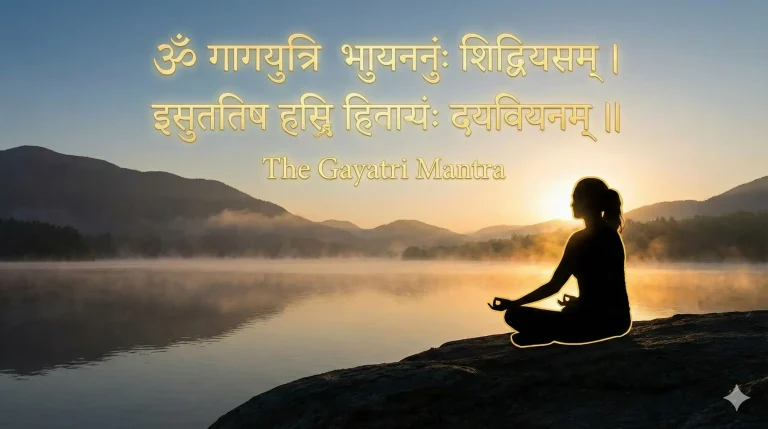
Om Bhur Bhuvah Svah
Tat Savitur Varenyam
Bhargo Devasya Dhimahi
Dhiyo Yo Nah Prachodayat
While interpretations can vary slightly, a comprehensive translation resonates as:
“We meditate on that most adored Supreme Lord, the creator, whose divine light illumines all realms (physical, mental, and spiritual). May this divine light illumine our intellect.”
Broken down, we can see the journey the mantra takes us on:
Om: The primeval sound, the sound of the universe.
Bhur Bhuvah Svah: The physical, astral, and celestial planes. We are acknowledging that the Divine exists in all layers of reality.
Tat Savitur Varenyam: That adorable, supreme source of life and light.
Bhargo Devasya Dhimahi: We meditate upon that light which destroys the darkness of ignorance.
Dhiyo Yo Nah Prachodayat: May that light propel our intellect and intuition in the right direction.
The Effect on the Mental, Emotional, and Spiritual Bodies
I mentioned earlier that this mantra helps my mental, emotional, and spiritual bodies, and I want to dive deeper into how that works. We often think of ourselves as just a physical body with a brain that thinks, but we are a complex layering of energetic fields.
The Mental Body
The mental body is often a chaotic place, filled with “chatter.” Anxiety, planning, replaying old conversations—this is the noise of the mental body. The rhythmic chanting of the Gayatri demands focus. You cannot chant it properly while thinking about your grocery list. This focus creates a “unidirectional” flow of mind. It calms the scattered waves of thought, bringing a profound stillness. It trains the brain to focus, improving neuroplasticity and cognitive clarity.
The Emotional Body
Emotions are energy in motion. Often, we store stagnant emotions—old grief, frustration, or resentment—in our energetic field. The vibration of the Gayatri is high frequency. By laws of resonance, a high-frequency vibration will disrupt and loosen low-frequency vibrations. I have found that consistent chanting can bring up old emotions to be released, leaving a sense of lightness and emotional balance in their wake.
It is a tool for emotional digestion.
The Spiritual Body
This is the realm of connection. This is where the mantra deepens the link to inner wisdom and your guide team. When we chant, we are tuning our “radio receiver” to the frequency of the Divine. We are clearing the static. I believe that our guides are always whispering to us, but often our internal noise is too loud to hear them. The Gayatri turns down the noise and turns up the signal.
It acts as a bridge, linking human awareness with divine wisdom.
Spiritual Responsibility and Maturity
There is an aspect of the Gayatri that speaks to spiritual maturity. In many traditions, being initiated into the Gayatri Mantra was seen as a rite of passage—a step into adulthood.
Why? Because chanting it is an act of taking responsibility for your own light. It is a choice. You are choosing, consciously, to awaken your inner light rather than waiting for the world to bring you happiness. You are choosing to align with truth. It signifies a move away from victimhood (“Why is this happening to me?”) to a place of empowered wisdom (“Grant me the clarity to navigate this”).
A Global Perspective: From India to Bali and Beyond
The beauty of the Gayatri Mantra is that while it has roots, it has wings. It is not confined to one geography, though its traditional usage offers us beautiful context.
Alignment in India
In India, the mantra holds a deeply sacred place. It is associated with Gayatri Devi, the embodiment of divine wisdom. Traditionally, it is part of the Sandhya Vandanam rituals performed at the “junctions” of the day—sunrise, noon, and sunset. These are times when the energy of the atmosphere shifts, making them potent windows for spiritual practice.
In India, it is used by Brahmins, householders, ascetics, and devotees alike. While historically there were restrictions in ancient times regarding who could chant it, in the modern spiritual era, it is widely accepted that the Gayatri transcends caste, gender, and religious boundaries when approached with sincerity.
Alignment in Balinese Hinduism
Many Australians feel a deep spiritual connection to Bali, and it is fascinating to see how the mantra lives there. Balinese Hinduism (Agama Hindu Dharma) carries its own unique cosmology and ritual life.
In Bali, the Gayatri Mantra is recognised and respected, though it is not commonly chanted in daily temple practice exactly the way it is in India. Balinese rituals focus more heavily on the Tri Sandhya, Gayatri Stuti, and mantras specific to Balinese cosmology. However, the core principles align naturally. The Balinese spiritual values of honouring light, purity, balance, and cosmic order are perfectly mirrored in the essence of the Gayatri. It serves as a reminder that truth is universal, even if the rituals surrounding it change from culture to culture.
How to Integrate the Gayatri into Your Every Day
You do not need to be an ascetic living in a cave to reap the benefits of this practice. In fact, this mantra is perfect for the modern individual because it is efficient and potent.
Here is how you can begin to include it in your daily routine:
1. The Morning Window
Ideally, chant this mantra first thing in the morning. The time just before or during sunrise (known as Brahma Muhurta) is considered the most auspicious, as the world is quiet and the veil between the physical and spiritual is thin. However, if 4:30 AM isn’t realistic for you, simply doing it upon waking, before looking at your phone, is powerful.
2. Create a Sacred Container
Sit comfortably with your spine straight. You can sit on a cushion on the floor or in a chair. The straight spine allows energy to flow freely. Close your eyes and take a few deep breaths to centre yourself.
3. Invocation and Chanting
You can listen to a recording to learn the pronunciation, but the true power comes from using your own voice. The vibration should be felt in your chest and throat.
Repetition: Traditionally, mantras are chanted 108 times (using a Mala bead necklace to count). This takes about 15 to 20 minutes.
The “Lite” Version: If 108 feels daunting, start with 27 repetitions, or even just 3 repetitions done with absolute focus and sincerity. Consistency is more important than volume.
4. Visualisation
As you chant, visualise the sun. Imagine a brilliant, golden light at the centre of your chest (the heart centre) or at the point between your eyebrows (the third eye). With every chant, imagine this light expanding, burning away fog, doubt, and negativity, filling your entire body with radiance.
5. Silence
This is the most important step. After you finish your chanting, do not immediately jump up to make coffee. Sit in silence for at least two minutes. The mantra stirs up the energy; the silence is where the energy integrates. This is the moment where you might receive insights from your inner wisdom or your guide team. Listen to the quiet.
A Challenge for 2026
If you are looking for a way to shift your vibration this year, I invite you to try a 21-day experiment.
Commit to chanting the Gayatri Mantra every morning for the next three weeks. It doesn’t have to be long—five minutes is enough. Observe how your days change. Notice if you feel more patient in traffic, more clear-headed in meetings, or more compassionate toward yourself when things go wrong.
I believe you will find, as I have, that this ancient arrangement of sounds is much more than words. It is a pathway home to the self. It is a daily reminder that no matter what is happening in the external world, the sun of consciousness is always shining within you, waiting to be acknowledged.
Make 2026 your year of light, clarity, and awakened wisdom.
** My personal favourite artists that sing beautiful versions of the Gaytri Mantra are Edo & Jo, Radical Devotion and Deva Premal (in that order).